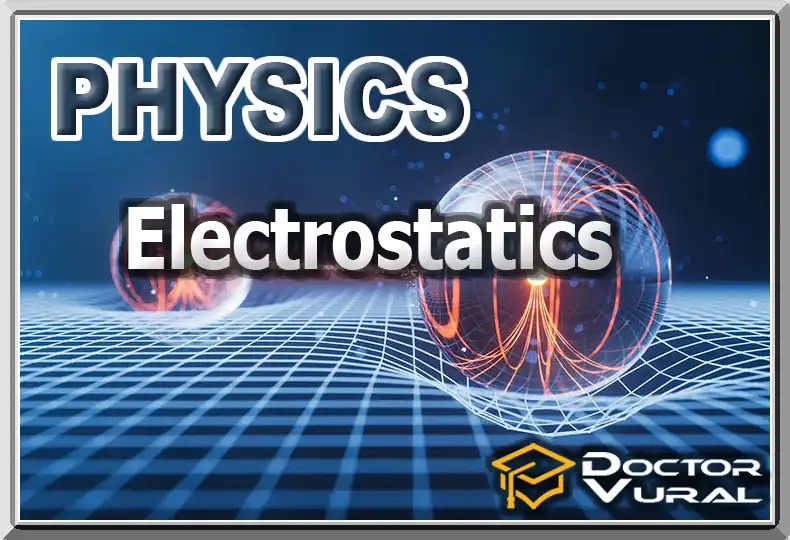
Electrostatics
Learning Time: 4-12 hours
Content: Electrostatics is the study of the behavior of electric charges at rest. This subject covers the nature of charges (positive, negative), Coulomb’s Law, electric fields, potential differences, and charge distribution. The TYT focuses on fundamental charge interactions, while the AYT focuses on the mathematical model of the electric field. The current 2025 curriculum also covers electrostatic technologies (electrostatic precipitators) and their environmental applications. Learning this topic provides the foundation for understanding electrical phenomena.
- Electric Charges:
- Definition of Charges (Positive and Negative)
- Law of Conservation of Charge
- Charge Transfer (Friction, Contact, Induction)
- Coulomb’s Law:
- Calculation of Force (F = k.q₁.q₂/r²)
- Effect of Charge and Distance
- K Coulomb’s Constant
- Electric Field:
- Definition of the Electric Field (E = F/q)
- Field Lines and Equipotential Surfaces
- Point Charge and Plate Areas
- Electric Potential:
- Potential Difference (Voltage)
- Potential Energy (U = qV)
- Equipotential Surfaces
- Applications:
- Electrostatic Sprayers
- Xerox and Printer Technology
- Lightning Protection Systems
- Affecting Factors:
- Ambient Dielectrics
- Humidity and Temperature
- Charge Distribution
Course Features
- Lectures 0
- Quizzes 0
- Duration 5 hours
- Skill level Intermediate
- Language English
- Students 15
- Assessments Yes